Who Will be India's Next Prime Minister?
By IANS - NEW DELHI
Published: 05th March 2014 06:05 PM
Last Updated: 05th March 2014 06:05 PM
In what will be one of India's most keenly watched Lok Sabha elections, the only declared prime ministerial candidate is pitted against many more hopefuls.
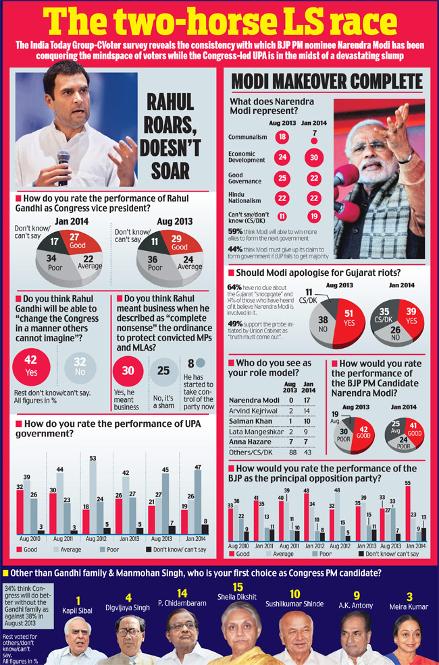
With the Congress shying away from naming a nominee for the top post, BJP's Narendra Modi is the only prime ministerial choice of any political party. The Bharatiya Janata Party named Modi in September last year, much ahead of the polls to the 545-seat Indian parliament. By all accounts, Modi, the four-time Gujarat chief minister, is a picture of confidence.
In sharp contrast is the Congress, which looks a pale shadow of its 2009 health when it stunned friends and foes by winning more seats than in 2004 with Manmohan Singh and Sonia Gandhi at the helm. The Congress has shied away from naming a prime ministerial nominee. But Rahul Gandhi, who leads its election campaign, is widely viewed as the man who will get the post in the unlikely event of a Congress victory.
But with the coming election widely expected to produce another hung Lok Sabha, the value of regional leaders has gone up sharply. And some of them do not hide their eagerness to play a larger national role.
Tamil Nadu Chief Minister J. Jayalalithaa is one of them.
Once a known admirer of Modi, the AIADMK chief is seeking to bag as many of the 39 Lok Sabha seats in Tamil Nadu so as to command an enviable clout in the new Lok Sabha. Already, Chennai and other parts of Tamil Nadu are awash with posters describing Jayalalithaa as India's future prime minister.
The other woman politician who has developed a taste for national politics is West Bengal Chief Minister Mamata Banerjee. Gandhian activist Anna Hazare has come out in support of her -- and vowed to campaign for her Trinamool Congress across the country.
This has upset Hazare's former protege and Aam Aadmi Party (AAP) leader Arvind Kejriwal, who too is widely seen as a prime minister in the making.
Already, national surveys are clubbing the former Delhi chief minister along with Modi and Rahul Gandhi while debating who is best suited to rule India.
Bahujan Samaj Party chief Mayawati has always been a dark horse -- and remains so this time too.
At a recent election rally, she said conspiracies were afoot to stop a "Dalit leader" from becoming the prime minister, in an apparent reference to herself.
But Samajwadi Party chief Mulayam Singh Yadav's stock has receded in the wake of the communal clashes in Muzaffarnagar and the widespread criticism of his son and Uttar Pradesh Chief Minister Akhilesh Yadav.
Mulayam Singh Yadav could have become the prime minister at the head of a centre-Left United Front government in 1996. But the baton went instead to Janata Dal-Secular leader H.D. Dewe Gowda.
Any regional leader who can even aspire to be counted as a kingmaker in the event the major parties are unable to form a coalition government will have to command a respectable number of MPs.
Deve Gowda is more or less out of the reckoning now. And so is Sharad Pawar, who certainly looks jaded compared to earlier elections. His party, the NCP, has hardly expanded significantly beyond Maharashtra.
Nitish Kumar, once the poster boy of the BJP-led National Democratic Alliance, was considered a prime ministerial contender. But his influence has wanted after he ended his 17-year-old alliance with the BJP.
Some analysts have a dim view of most regional aspirants.
"Everything will hinge on gets how many seats," political commentator Neerja Chowdhury told IANS.
Pradip Kumar Datta, former head of the political science department at Delhi University, added: "Regional party leaders have limited prospects as it's difficult to develop consensus on one (person)."
Chowdhury stressed that with the anti-incumbency factor, the real contest would be between the BJP and an alliance of non-Congress, non-BJP parties, indicating the Congress could end up at the third place.
"If Modi can't cobble together a government, regional parties will stand a chance," she added.
She also felt that Naveen Patnaik of the Biju Janata Dal in Odisha could be acceptable to many if the BJP failed to take power.
Political observer B.R.P. Bhaskar told IANS: "There is nothing wrong in aspiring to be a prime minister. But we have to see if regional parties can address national aspirations."
Chowdhury had another angle.
"If there is a scenario where the BJP gets stuck around 160 seats, Modi may not be the most acceptable candidate for allies," she said. "In such a scenario, L.K. Advani will have a chance."
Not everyone agrees -- since parties allied with the BJP now fully back Modi.
Communist Party of India's D. Raja feels an advance declaration of a prime ministerial candidate is "subversion of India's parliamentary system".
"They are trying to make it a quasi-presidential election," Raja told IANS.
Irrespective of who becomes India's next prime minister....???
---------ARAVIND SAINI |
The Great Congress meltdown: BJP set to emerge as single largest party at the expense of GOP
- The BJP is emerging as undisputed single largest party in India, crossing their previous best of 182 seats in 1999. In terms of vote share, it might just cross the psychologically important 30 per cent vote mark which has eluded the BJP all along. The real swing for the BJP is coming from the Hindi heartland, especially in the states where the contest is primarily bipolar between the Congress and the BJP. In states like Gujarat, Rajasthan, Madhya Pradesh, Chhattisgarh, Himachal Pradesh, Uttarakhand, Goa and Jharkhand the Congress meltdown is complete. Same is the case where a direct contest of UPA/NDA is on cards, including Maharashtra and Punjab. The face-savers for the Congress are just the two states of Karnataka and Assam.
LIKE us on "fb" : https://www.facebook.com/indianpolitics9 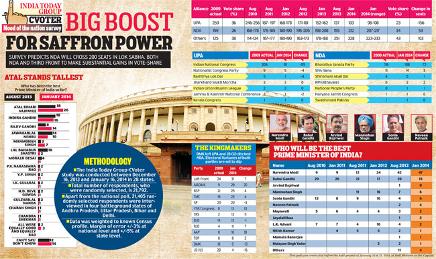
-The second component of the AAP vote in the urban middle class voters who are primarily anti-Congress. These voters will increase the cumulative vote share of the AAP in urban seats across India. The third component is the nonpolitical passive voter, which might go out to vote and increase the turnout and share of the AAP at large.
- Other than these areas, the AAP is not getting big time support in the rest of India, especially in rural areas at the moment. However, even with just an additional 5 per cent national swing, they can cross 30 seats in Parliament and unsettle the probable equations. However, it must be kept in mind that it's never the spread of the votes but the strategic concentration of votes which make you win the seats. The BJP in 1984 got approximately 8 per cent votes but ended up with just 2 seats. It was the strategic concentration and adjustment in 1989 which resulted in mere 9 per cent votes but an impressive 84 seats in Parliament. Similarly, the BSP became the third largest political party in India years back in terms of vote share. But it is the inability to concentrate which made it impossible for them to win seats outside Uttar Pradesh. In other words, the AAP phenomenon is largely like the BSP phenomenon. Like the BSP is concentrated in Uttar Pradesh, the AAP will be concentrated in Delhi and the adjoining NCR seats. Outside this "ground zero" they will gain votes like the BSP has been doing in the last 20 years but the number of such votes will not cross the "threshold" to convert into seats big time.
LIKE US ON "FB" :: www.facebook.com/indianpolitics9
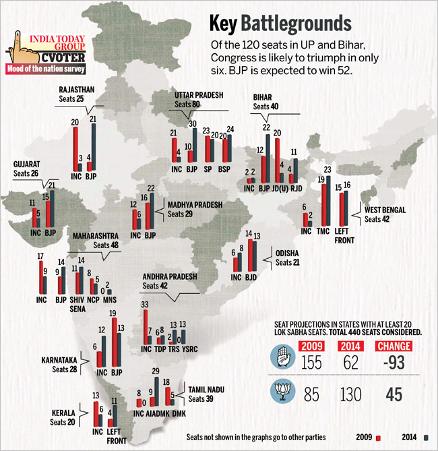
-If the upswing for the AAP, however contiues to gather momentum across middle class and urban areas and this manages additional national swing of 10 per cent votes, it might very well take them within striking distance of eclipsing the Congress. This has more to do with the Congress meltdown in terms of seats across India. However; this certainly is a herculean task given the fact that the AAP wave is largely a middleclass and urban phenomenon, that too mostly in adjoining regions of Delhi NCR. On the other hand, regardless of the downswing across India, the worst ever the Congress fared in terms of vote share still remains approximately 20 per cent. This is its core support base. Almost every fifth Indian will still vote for the Congress in its worst possible hour. This is an extremely important finding because to bounce back in future, this is the core support base that any party counts on. From that perspective, the task of Rahul Gandhi to revive the Congress from scratch seems not that difficult. The seats tally might look depressing for the Congress, but it's in the votes that the future of the party is to be seen. As they say one week is a long time in politics, and we are still 12 weeks away from the polls.
LIKE ON "FB" :: www.facebook.com/indianpolitics9
written by --ARAVIND SAINI |